





The Power of Listening: When the Journey Becomes Transformation
Flaminia Munafò
5/7/20265 min leer
There are experiences that cannot be fully explained, because they do not belong only to the mind, but to the body, to the senses, to something more subtle.
The Tomatis Method arises precisely from this intuition: listening is not a passive act, but a door, a threshold through which we can rediscover balance, presence and openness.
Through filtered and modulated sounds, this approach accompanies the nervous system into a different, more receptive, softer state of being. The method is used in different fields — from language learning to personal well-being — but its essence remains the same: to create a space in which something inside us can finally relax.
My encounter with this method was not planned, as it often happens with important things.
I left Italy for India with a clear intention: to practice yoga, to immerse myself, to listen, to give myself the space I needed after a year of many ups and downs following a toxic relationship. The idea was to stay for a month, practice with my guru in the city of Mysore, and then return, ready and with the right tools to take my life back.
There is a Hebrew proverb that says: man plans and God laughs. And it is in this very moment, when I had everything clearly planned in my mind, that the journey decided to rewrite itself. Because of the war in Iran, my return, initially planned for March 31st, was postponed without a defined date, opening the space to a suspended time that at first seemed unexpected, but that instead proved to be necessary.
After a month in Mysore, rather intense and painful — India is not for beginners :) — I felt the need to move, to change place. Tamil Nadu had been calling me for a long time, and Pondicherry was a curiosity I had never explored. For years I imagined myself wearing a light cotton dress, one of those with colorful prints, walking along the beach of what was once a French colony in the South of India, sipping a coconut to refresh myself from the heat. I imagined this journey with a potential partner, a husband, a lover. And instead, I found myself there, alone, in the middle of a long-distance breakup, without a return date on the horizon.
Pondicherry had been calling me for years, and I did not know why, until I ended up there. It was exactly as I had imagined it, but there was one detail I did not know, despite being a yoga practitioner for 10 years. Pondicherry is the city that hosts the ashram of Sri Aurobindo, whose vision of human unity and spiritual evolution inspired The Mother to found the city of Auroville in 1968. And it is there, in Auroville, that I arrived, almost without really choosing it.
Auroville is difficult to explain. It is a place conceived for the unity of the human being, an experiment, a shared dream. And perhaps precisely for this reason, certain experiences become possible there.
Auroville is such a unique place that it even hosts a linguistic research center, the Auroville Language Lab: here not only language courses are offered, but it is also possible to experience therapeutic sessions for the treatment of cognitive disorders such as dyslexia, autism, ADHD, as well as emotional difficulties such as anxiety and depression.
This therapeutic method, focused on the re-education of listening, is called Tomatis Method, from the name of the French doctor who introduced it into the scientific world towards the end of the 1950s.
I am fully convinced that everything happens for a reason, and precisely when I arrived at the Language Lab in Auroville, my natural tendency toward communication led me to speak with a French woman who was there, whom I later discovered to be one of the people responsible for the center. While we were talking about this and that, I told her who I am and what I do, obviously telling her that I was very interested in the method in its application to language learning. Isabelle then put me in contact with Mitha, the founder of the Language Lab, who, having understood my interest, extraordinarily gave me the opportunity to experience a session of the method, to understand how a typical session works.
And it is there that the journey truly began…
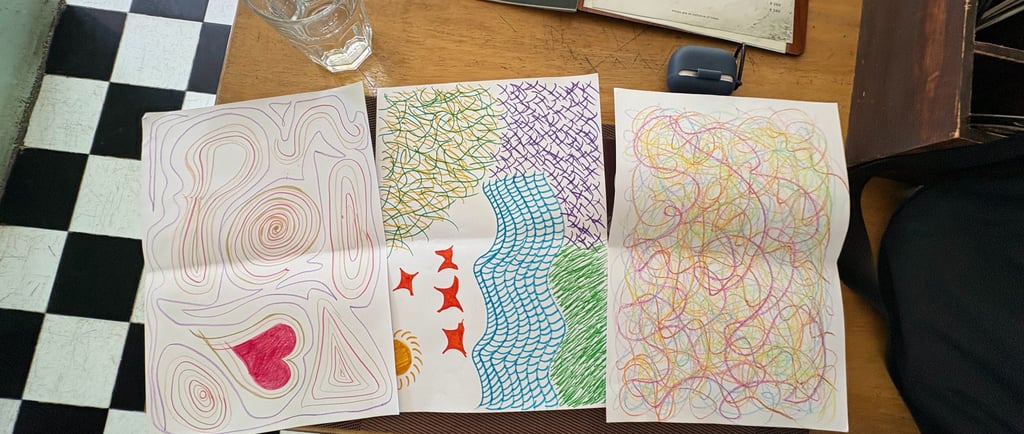
An Indian woman who works at the center guided me toward a room, very simple: a table with papers and colors, a chair, a bed. The instructions were simple: listen to what comes through the headphones, you can draw, rest, or sleep.
I sat down, initially tuning into what I was receiving in the headphones. I could perceive sounds only from the left ear, while the right perceived silence. At a certain point I began to hear from both, and once “tuned,” I picked up a color and started…
The headphones, designed to transmit sound also through the bones, created something difficult to describe: I was not only listening, I was feeling the sound inside. My hand moved on its own, following the rhythm. The drawings were simple, almost childlike, without filters, without intention. It was as if a part of me, silent for a long time, had finally found space. The music moved from a playlist of classical music to Gregorian chants, at which point I physically felt the need to lie down on the bed next to me. Once lying down, I placed my hands on my belly, and then something incredible happened: my mind stopped. There were no thoughts pulling in one direction or another, only presence. I was there. Completely. Until I fell asleep without even realizing it. When the session ended, I slowly opened my eyes.
I felt rested, but not like after sleeping. It was a deeper rest, as if something inside had quietly rearranged itself.
In a world where we are constantly bombarded by information, news, noise, thoughts, perhaps we forget too often that our natural state is not tension. When we truly relax, without effort, our potential does not decrease, but on the contrary, expands. In silence, something opens, and when we reconnect with ourselves, without noise, without pressure, a light emerges. The most wonderful thing is that it is not something to build, but something you can allow to emerge. To do so, however, we need space, listening and safety.
This experience made me reflect deeply on the way we learn, not only a language, but in general. What if learning did not require effort, but conditions?
Imagine a space where judgment does not exist, where you do not have to prove anything, where there are no grades, nor performance. A space that welcomes, that supports, that “cradles.” A place where you can make mistakes without fear, speak without filters, exist without contracting yourself.
It is in such a space that language becomes alive again, natural, fluid, just as it happens when one is still in the mother’s womb. Just as it happened to me, in that room in Auroville, while I was drawing without thinking.
Perhaps learning a language is not about accumulating rules, perhaps it is about remembering how to listen, and, at the same time, allowing something within us to respond.
I would like to conclude this short article with a reflection, and I quote verbatim Thomas Harms, author of the preface of the book From Resonance to Bonding, by Dirk Beckerdorf and Franz Muller: “[…] we live in a deaf world. This deafness described by the authors goes far beyond a purely physiological deafness. It concerns a deeper psycho-physical dimension of hearing that now pervades our modern society. More precisely, it is about the massive loss of the ability to listen, body and soul, to another person — a listening that reaches the heart of another person.”
May we rediscover the ability to listen to ourselves all, in a world full of emotional coldness, superficiality and paucity of bonding. May the profession of the linguist — whether teacher or interpreter/translator — not be limited to the mere analysis of what is said and how it is said, but rather to the reason why that lies behind the deepest need of the human being to communicate with oneself and with others.
*Publication of the Auroville Language Lab